Articles
What is supply chain transformation? A guide for UK businesses
At the Digital Supply Chain Hub, we believe supply chain transformation creates opportunities to improve productivity, resilience, and sustainability for businesses across the UK.
However, digitalisation and the prospect of changing established processes can be daunting for many companies - whether it is navigating emerging technologies, selecting the right partners, or ensuring that they have the right skills available.
Jump to a section:
What is Supply Chain Transformation?
Why transformation has moved up the agenda?
The five dimensions of a ready supply chain
Key technologies driving supply chain transformation
Common barriers and how to approach them
Real supply chain transformation examples
How to start a supply chain transformation
What is supply chain transformation?
At its core, supply chain transformation is the intentional shift from how a supply chain operates in its current form to how it needs to operate in the future, using digital technology, restructured processes, and better collaboration to get there.
It may involve changes such as:
- automating manual tasks using digital or AI tools
- connecting previously siloed data systems
- improving visibility across the supplier network
- adopting predictive tools to be more proactive
- sharing data intentionally with customers and suppliers
“What distinguishes transformation from a standalone improvement project is scope and intent. Rather than working in silos and fixing individual processes, you're taking a holistic approach and evaluating the entire value chain. Done well, this can lead to immediate productivity gains as well as improving resilience over the longer-term.”
Ravi Gidoomal, Director, EDGE Digital Manufacturing
Some organisations treat supply chain transformation as a technology project. Others see it as a process review. In practice, it is both, and it touches almost every part of a business.
Supply chain transformation typically covers several interconnected areas:
- procurement and supplier management
- inventory and demand planning
- logistics and transportation
- production scheduling
- the flow of data between all of these
- product lifecycle management
- circularity (reuse, recycle, remanufacture)
- regulatory compliance
The goal is to have a supply chain that is more efficient, resilient, and better aligned with the wider business. This is vital for businesses that want to stay ahead of the competition.
Why transformation has moved up the agenda?
Global supply chains have experienced significant disruption and changes in recent years. Understanding the causes and effects is essential for businesses to determine how they can adapt and respond to future challenges and drive resilience as part of a transformation strategy.
After the pandemic, weaknesses in supply chains became more visible. Port congestion, material shortages, labour gaps, and single-source dependencies all compounded at once.
Geopolitical instability continues to create unpredictability in global trade routes. Consumer expectations have risen sharply, with faster fulfilment now a baseline assumption rather than a differentiator.
In addition, regulatory requirements around supply chain due diligence are also expanding, particularly around labour standards and environmental reporting, with the upcoming European Commission Corporate Sustainability Due Diligence Directive (CSDDD) requiring qualifying large companies to identify, prevent, and mitigate negative human rights and environmental impacts across their global operations and value chains.
To respond to these challenges, organisations no longer need to be limited to reactive approaches. Deep tech is enabling businesses to strengthen resilience, improve visibility, and respond more effectively to uncertainty by leveraging real-time insights, predictive capabilities, and greater automation.
Artificial intelligence (AI), machine learning, internet of things (IoT), and cloud-based platforms have moved from emerging technologies to being in everyday use, with proven results. For businesses that adopt and apply these technologies, many often see improvements in service levels, costs, and speed, as demonstrated in the Digital Supply Chain Hub’s supply chain case studies section.
From using AI to tackle supply and demand with Singular Intelligence, to reducing manual data collection with Looper Tech’s advanced enterprise software or enhancing visibility of packaging availability with Mavarick AI’s supply chain intelligence platform, these real life examples demonstrate how technology is key to driving supply chain transformation.
For any business interested in seeing what this looks like in practice, the Digital Supply Chain Hub’s practical tools are designed to help kick-start a transformation journey, identifying which technologies and solutions are the right fit for business operations.
The five dimensions of a ready supply chain
Before getting started with supply chain transformation, a business should consider where it currently stands. Jumping into unplanned digitalisation can be costly further down the line.
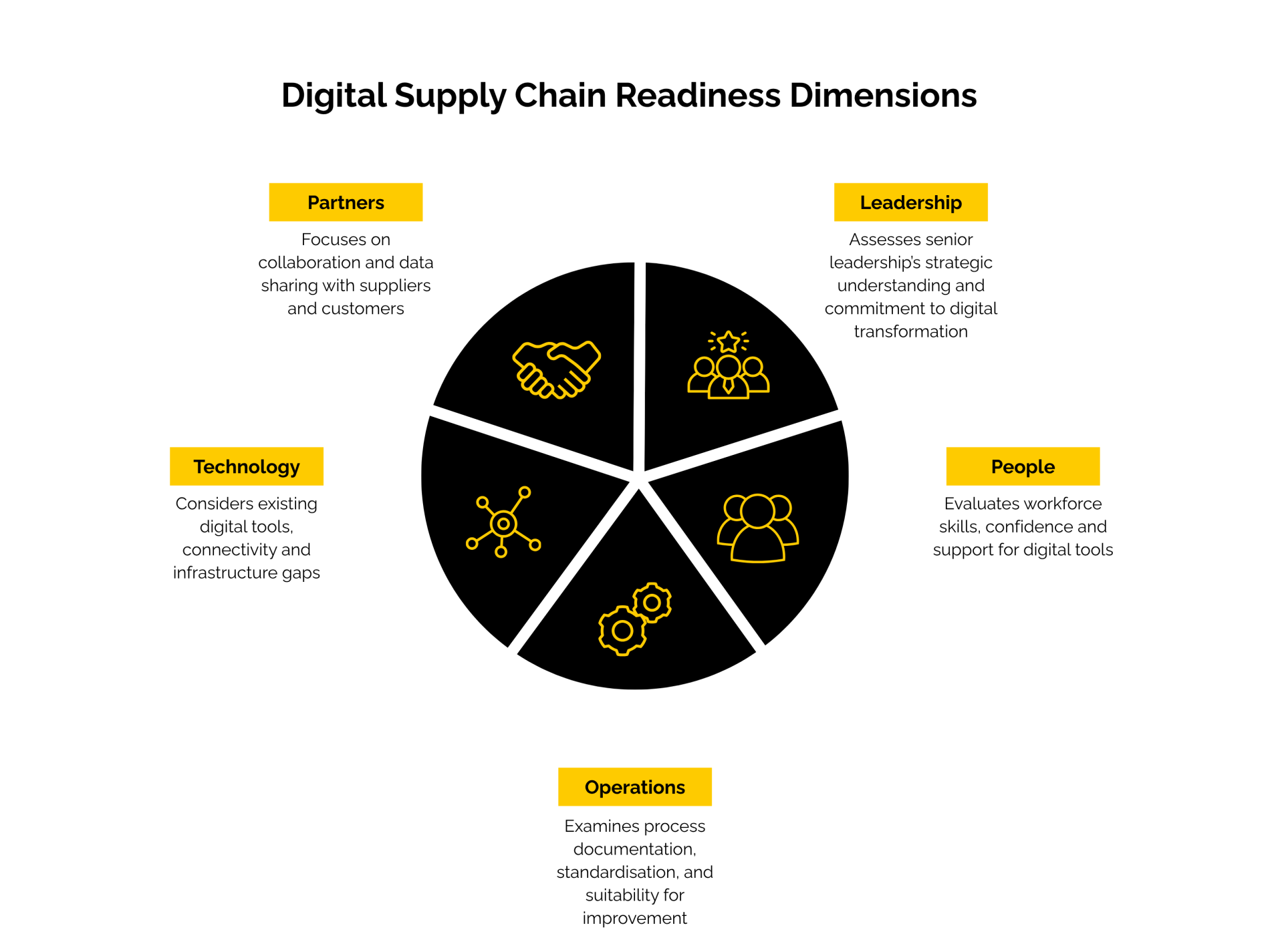
The Digital Supply Chain Hub uses a structured framework built on five dimensions to help manufacturing businesses assess their readiness. This is grounded in the principles established in the Adopting Digital Technologies in Manufacturing Guide - PAS 1040 and gives a practical starting point for any transformation conversation.
1. Leadership
How engaged is a senior leadership team with supply chain capability?
Do they recognise the potential strategic value it can offer to the business? Transformation without leadership commitment rarely takes hold in a business.
2. People
How will a workforce be upskilled and how will a business ensure that the right training is in place? Is a business investing in its workforce so that they have the skills, confidence and capacity to work with digital tools and data-driven processes?
Transformation creates change, and change requires people who are supported and trained. The Digital Supply Chain Hub offers a suite of free supply chain courses designed to build a foundation for businesses who are starting their transformation journeys.
Organisations that underestimate this dimension tend to struggle with adoption long after the technology is in place.
3. Operations
How well are current processes documented and standardised? Has a business identified where customers’ experiences could be improved, or where to make cost savings or improve performance?
Automating a broken process does not fix it. It just speeds it up. Getting operational foundations right before layering technology on top of them matters.
4. Technology
How confident is a business leader in their current systems and technology? What technologies have they seen or heard about from working with peers and competitors?
Technology includes a company’s Enterprise Resource Planning (ERP) and warehouse management systems through to the data infrastructure that sits beneath them.
Successful transformation requires a good understanding of what a business currently has in place, how well systems connect and work together, and where the gaps are.
5. Partners
How well does a business collaborate with suppliers, customers and other organisations across a value chain?
What data, metrics and performance indicators are measured and shared with each other?
Supply chain transformation does not stop at changing the way a business operates. The ability to share data, coordinate planning, and build trusted relationships with partners and suppliers is critical to the resilience of supply chains.
These five dimensions do not need to be transformed simultaneously, but understanding a position across all of them gives a far clearer picture of where to focus.
“We worked with a growing manufacturer active in the offshore and onshore energy sector. They had strong experience of digital adoption across their own business and wanted to enable their key suppliers to collaborate more effectively, identify cost savings and improve environmental sustainability. Suppliers were invited to complete the Digital Supply Chain Readiness diagnostic with findings used to develop a shared digital roadmap and identify individual and collaborative transformation opportunities.”
Ravi Gidoomal, Director, EDGE Digital Manufacturing
Key technologies driving supply chain transformation

Digitalisation is a key enabler for supply chain transformation.
Starting with a clear understanding of a supply chain challenge within a business is an effective way to identify the most suitable digital tools.
From our experience, this leads to more sustainable change compared with leading with a technology purchase and hoping for the best.
AI and machine learning
AI and machine learning are changing how demand is forecast and how procurement decisions are made. Rather than relying on historical patterns alone, AI systems can factor in a much broader range of signals, from supplier lead time trends to weather forecasts.
As part of the Digital Supply Chain Hub’s Automotive Accelerator, Maverick AI demonstrated how automotive manufacturers can transform how they manage supply chain asset flows and achieve faster planner response times.
IoT and real-time tracking
IoT and real-time tracking can offer organisations visibility they simply did not have before. For example, container tracking systems can use sensors to monitor shipments continuously, allowing businesses to spot potential delays early and make decisions before problems arrive. That kind of visibility is now available at a broader scale for small businesses.
Cloud-based platforms
Cloud-based platforms make it easier to connect systems across organisations and geographies, reduce the cost of maintaining on-premises infrastructure, and give businesses access to capabilities that previously required significant IT resources.
Digital twins
Digital twins are an increasingly important area of technology. By creating a virtual model of the supply chain, organisations can simulate the impact of disruptions or decisions before committing to them. This is particularly useful for scenario planning in volatile conditions.
The UK Digital Twin Centre, delivered by Digital Catapult, is making digital twins more accessible across the UK by helping organisations unlock their potential through collaboration, knowledge sharing and the practical application of emerging technologies.
Distributed ledger technology
Distributed ledger technology helps businesses prove where materials and goods have come from and tracks their movement across the end-to-end supply chain. This kind of visibility is becoming more important as regulatory and compliance pressure grows.
Factors such as geopolitical events and incoming requirements like digital product passports and due diligence regulations such as the CSDDD are adding to that pressure.
Ubloquity's distributed ledger platform shows what this looks like in practice. It captures data at source and keeps it available in a secure, tamper-proof record, supporting an 'earned trust' compliance model that reduces the need for repeated audits.
Through four testbeds, run as part of the Digital Supply Chain Hub programme, end-to-end digital twins, which replicated the flow of information, goods, and money through a supply chain were developed for various sectors, which allowed real-world testing of supply chain strategies without disrupting business operations.
“Using AI and automation we can interrogate our existing data and seamlessly manage interactions with our supply chain.”
Nathan Bailey, Managing Director, Advanced Innovative Engineering
No single technology solves everything. The supply chains achieving the most consistent results tend to combine several of these tools coherently, with good data governance.
Common barriers and how to approach them

Knowing what good looks like does not automatically make supply chain transformation easy. Many organisations encounter similar friction points as they change processes.
Siloed data and disconnected systems
Siloed data and disconnected systems are probably the most common underlying issue. When procurement, warehousing, logistics, and finance are each running separate systems with limited integration, visibility suffers and decision-making slows down. Addressing this often requires a deliberate data strategy before, or alongside, any technology investment.
Resistance to change within the business
People who have built expertise in a particular way of working do not always welcome the suggestion that it needs to change. The organisations that handle this well tend to involve frontline teams early and throughout the process, not just in the implementation phase.
Offering training and support can help a workforce to feel more informed about changing processes and therefore more invested. The Digital Supply Chain Hub provides a range of short online courses for organisations on their digital transformation journeys.
Lack of clear ownership
Supply chain transformation crosses functional boundaries, which means it can easily fall between teams within a business. Having someone with sufficient authority and cross-functional visibility to lead the programme makes a significant difference.
Starting too big
Starting too big is a surprisingly common mistake. Organisations that try to transform everything at once often find themselves overwhelmed and unable to demonstrate early progress. Starting with a well-defined part of the supply chain, proving the value, and then expanding tends to work better both practically and in terms of building internal confidence.
Poor data quality
Predictive tools are only as good as the data they run on. If historical records are incomplete, inconsistent, or siloed, the outputs will be unreliable. Cleaning and organising data before implementation can be seen as less important than selecting a technology provider, but it is essential.
Lack of trust or collaboration
Many of the barriers above are internal. But supply chain transformation increasingly depends on working closely with other organisations, and that introduces a different kind of challenge.
Our Logistics Living Lab project found that businesses can be protective of client relationships and wary of competitors gaining an advantage, which discourages the open data sharing that collaborative transformation depends on. This can be particularly important for sectors such as defence, where data is highly sensitive. Addressing this usually means agreeing clear data governance and ownership upfront, so each organisation keeps control of its own information while still benefiting from shared visibility.
“Strategic, operational and capability barriers can hold companies back from fully realising the business benefits from supply chain transformation. Lack of confidence is a common thread running through these challenges. How will this change impact our customers? Will supplier claims live up to the hype? Do we have the right skills within the business to support this transformation?”
Ravi Gidoomal, Director, EDGE Digital Manufacturing
Real supply chain transformation examples
The results achieved by organisations that have gone through a genuine transformation are worth keeping in mind when the process feels complex.
Companies working with the Digital Supply Chain Hub have delivered measurable outcomes. According to our Annual Impact Report 2025, participants achieved:
- 14% productivity increases
- 10% waste reduction
- 8% lower CO₂ emissions
- 13% cost decreases
Our Logistics Living Lab project, which explored load optimisation through shared return journeys, gives a specific example of what collaborative transformation can deliver.
A pilot scheme with AF Blakemore and Son resulted in a 9% improvement in vehicle fill rate and a 37% reduction in transport costs, alongside a reduction in carbon emissions.
“The solutions built through this unique industry collaboration deliver a triple benefit to the UK logistics sector by empowering the organisations that make up our complex supply chains, to become more efficient, reduce costs to improve their bottom line and make a lasting environmental difference to positively contribute to the future of the planet.”
Tim Lawrence, Director of the Digital Supply Chain Hub
Another example is Reverse Resources, a company working with textile recyclers through the Hub, which built a traceability tool that cut the time spent sourcing feedstock by up to 50%. A straightforward digital intervention addressing a specific operational pain point.
“By working closely with both Digital Catapult and the textile recycler iinouiio, we were able to create a feature that not only streamlines the management of critical documents for waste transactions between recyclers, manufacturers, and waste handlers but also significantly enhances the traceability and transparency of the textile recycling supply chain.”
Laura Sophia Stephen at Reverse Resources
Neither of these started with a technology platform. They started with a clear understanding of the problem, a collaborative relationship, and a willingness to test and learn.
How to start a supply chain transformation
A good starting place is to consider the supply chain transformation readiness within a business. Digital Supply Chain Readiness is the maturity of a business, or part of a business, or an individual in optimising its use of digital technologies to achieve its supply chain objectives.
The Digital Readiness Tool is designed to help manufacturing businesses assess their readiness. It is based on the principles of Digital Readiness established in British Standards' PAS1040:2019 and explores five dimensions: leadership, people, operations, technology, and partners.
The coffee table tool introduces our framework and provides guidance on how to improve in each dimension, with real-life examples and practical actions. All sections can be completed in under an hour, or users can focus on the dimensions that matter most. It can be completed individually, or the material and reflective questions can be used with a team.
If a business leader would prefer a more structured assessment, the full diagnostic takes 15 to 20 minutes to complete, covering around 40 to 50 questions with some guided training built in. Both tools give you practical recommendations, either on-screen or as a downloadable PDF.
Explore the Digital Readiness Tool
Join the Digital Supply Chain Hub
Supply chain transformation needs outside perspectives, whether that is from technology providers, researchers, or manufacturers who have overcome similar challenges.
The Digital Supply Chain Hub exists precisely to make connecting with supply chain experts easier, matching organisations with innovators across manufacturing and technology to accelerate the kind of collaboration that drives tangible results.
Join now to access free supply chain guidance and future-proof your business.
Join the Hub