
Articles
Cybersecurity in the connected supply chain
We live in an era where every product’s journey is mapped through a web of multiple digital systems, so the question of security is no longer confined to a single company’s network. It now spans the entire supply chain, from raw material extraction to delivering the finished goods.
The enhanced connectivity brings unprecedented efficiency but also creates many opportunities for adversaries to exploit weaknesses in systems and software. When a single link fails, the ripple can halt production, delay deliveries, and erode the confidence of customers.
Why is Cybersecurity in Supply Chains Important?
“Cybersecurity in Supply Chain is more important than ever. Just one successful cyber-attack could have a catastrophic impact on a business. An operations shutdown, inability to fulfil deliveries or customer orders has an immediate impact of lost sales as well as the risk of customers moving away permanently. Any data leak will seriously affect a business’s reputation amongst both customers and suppliers.”
Aleksander Gorkowienko, Platforms and Products Security Manager at Digital Catapult
Supply chains today are not static pipelines; they are dynamic ecosystems. A manufacturer receives design files from a design office, orders raw materials from a supplier, tracks shipments with GPS sensors, and finally delivers the product via a logistics partner.
Each of these handoffs relies on data exchange, cloud services, and automated controls. The more tightly the chain is integrated, the more valuable it becomes to attackers. A breach that compromises a relatively small supplier can expose confidential product specifications, delay critical shipments, or allow malicious actors to manipulate how the final product works.
The business impact could be devastating: lost revenue, contractual penalties, and damage to brand reputation. Also, the erosion of trust among partners can undermine future collaborations. In short: safeguarding the supply chain is a strategic imperative, not merely an IT add-on.
The potential impact of a cybersecurity breach in a digital supply chain can include:
- Operational shutdowns
- Delayed deliveries
- Manufacturing disruption
- Financial losses
- Loss of customer trust
- Supplier relationship damage
- Regulatory penalties
- Reputational harm

Vulnerable Connection Points
Digital supply chains depend on the continuous exchange of information between businesses, suppliers, technology providers, and customers. This often includes:
- Inventory and warehouse management systems
- Transportation and logistics platforms
- Supplier portals
- Customer delivery information
- Internet-facing IoT devices
- Enterprise software (self- and cloud-hosted)
- Automated manufacturing systems
Every connection point creates a potential vulnerability, making supply chain risk management essential for businesses in today’s climate. Cybercriminals for example, increasingly target supply chains because disrupting one organisation can create knock-on effects across multiple businesses and knock-on industries.
High-profile cyber-attacks have shown how vulnerable connected supply chains can be. Operational downtime, ransomware attacks, stolen customer data, and compromised supplier systems can all have long-term consequences.
For organisations operating automated warehouses or digitally connected manufacturing facilities, even short disruptions can stop fulfilment operations entirely.
Common Cybersecurity Risks in the Supply Chain
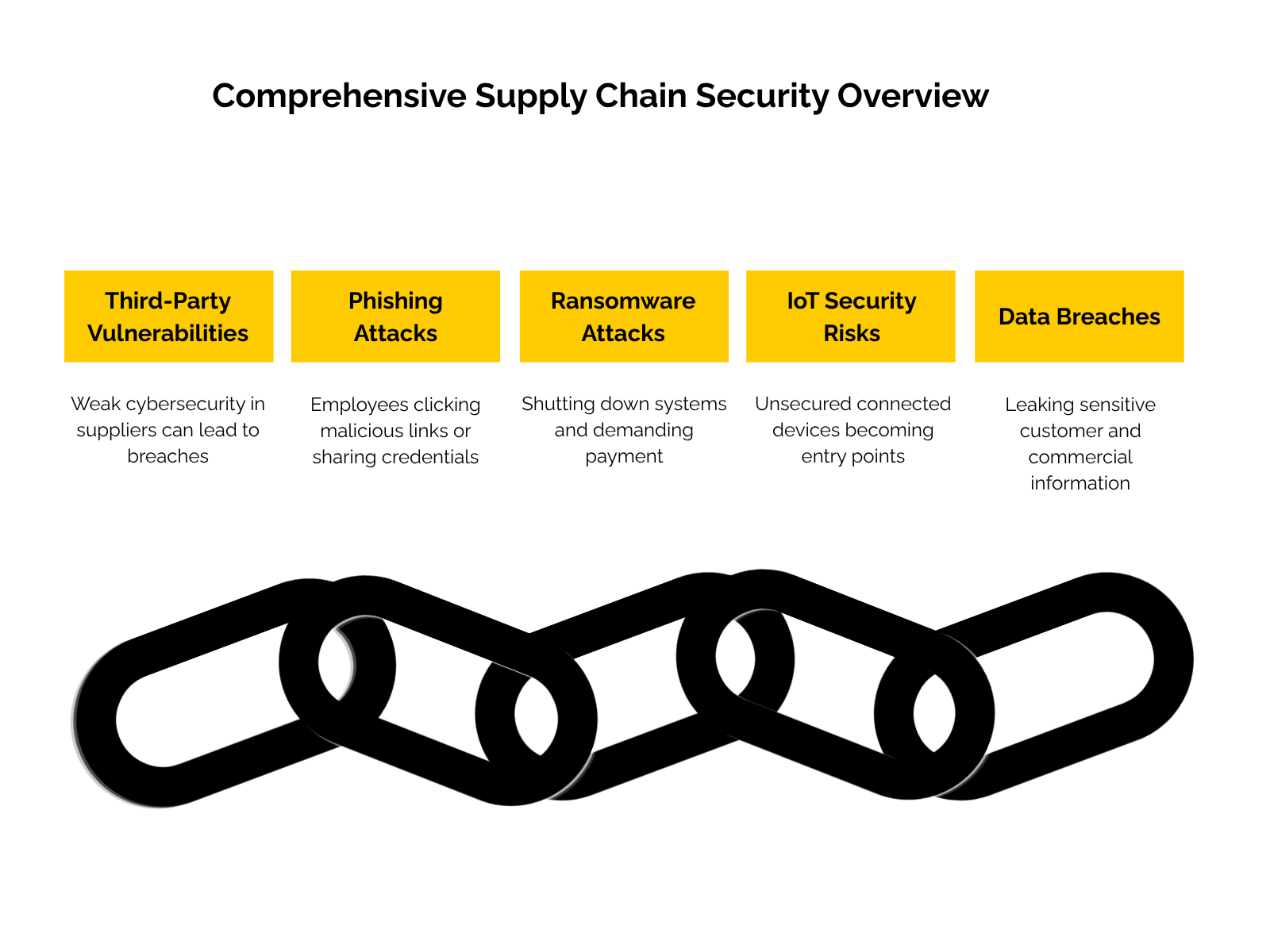
Here are some common risks and vulnerabilities within digital supply chain along with real-world examples.
Third-party supplier breaches remain a headline worthy concern. Large organisations often rely on dozens, sometimes hundreds, of smaller vendors. When one of them suffers a compromise, attackers can pivot through the network, reaching high value assets.
Phishing and social engineering attacks continue to be the most common initial intrusion vector. By impersonating trusted contacts, criminals trick employees into revealing credentials or approving fraudulent transactions.
Ransomware can bring an entire factory floor to a standstill. Encrypting control systems or inventory databases forces operators to negotiate with attackers, often under tight timelines that pressure the decision-making process.
IoT device exploitation is increasingly prevalent. Compromised sensors can feed false data into monitoring dashboards, leading to incorrect operational decisions or enabling sabotage.
Data leakage occurs when personal or commercial information is exposed through weak encryption, insecure APIs, or mishandled backups.
These threats are not isolated - they intertwine, creating complex attack scenarios that require layered mitigation.
Building a Resilient Supply Chain
“Businesses cannot afford to cut corners in this area and need to dedicate sufficient time to identify all risks. This might include war-gaming possible situations and putting in place measures to ensure that a lost password or phishing attack will have only limited impact.”
Aleksander Gorkowienko, Platforms and Products Security Manager at Digital Catapult
There is a wide range of actions you can take to improve your cybersecurity and operational resilience. Here are some of the first steps your business can take.
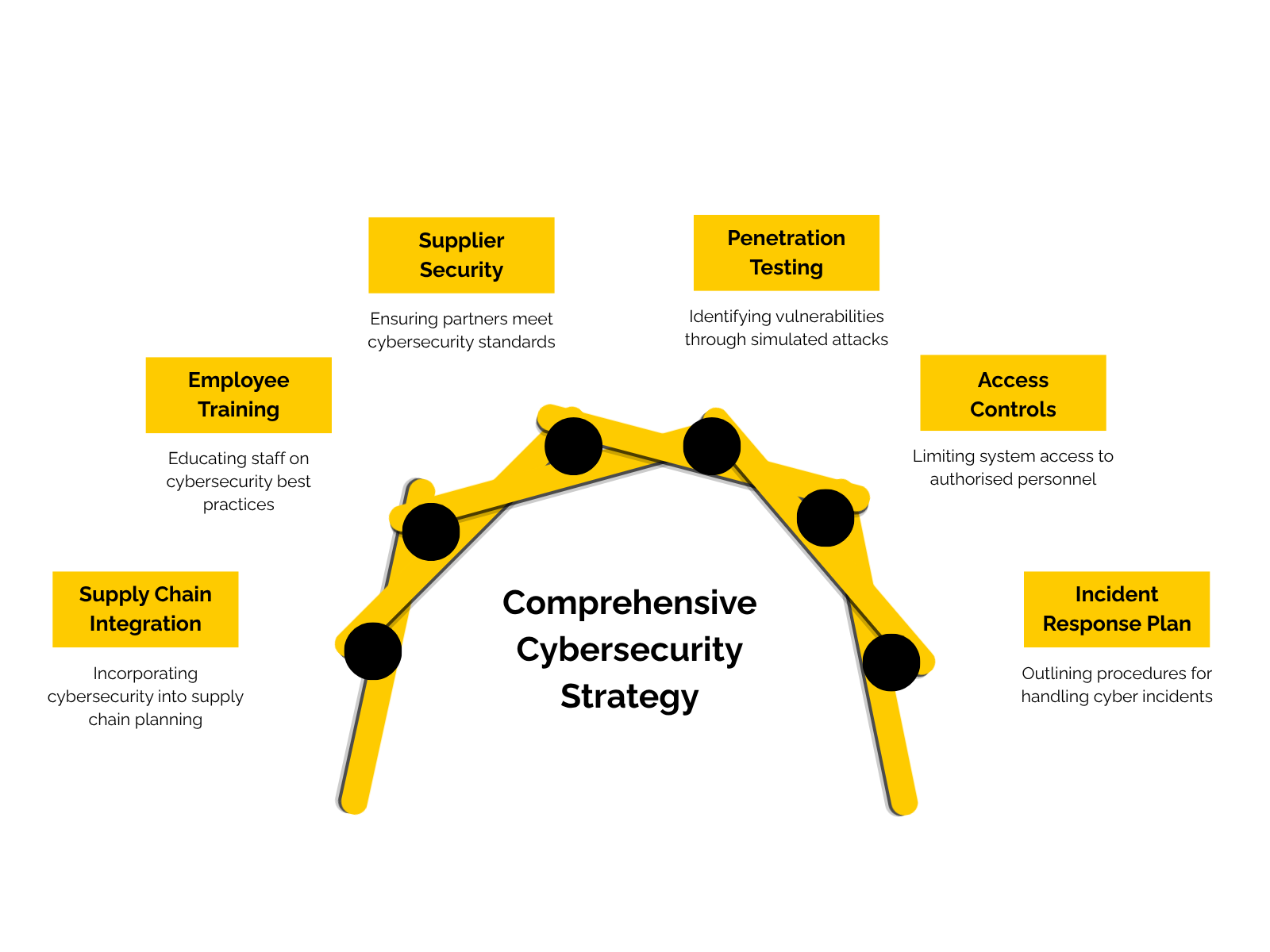
A robust approach begins with integration of security into the very fabric of procurement and operations. Companies should conduct thorough security assessments before onboarding any new vendor, demanding evidence of compliance with recognised standards such as ISO 27001 or Cyber Essentials. Ongoing monitoring - periodic audits, automated compliance checks, and continuous security awareness training – all of it helps maintain vigilance across the network.
Equally important is the human factor. Employees who handle contracts, orders, and supplier communications must understand how to spot phishing attempts, follow secure handling procedures for sensitive files, and report anomalies promptly. Simulated phishing campaigns, coupled with targeted education, reinforce this awareness.
Technical safeguards must address both legacy and modern assets. Upgrading outdated warehouse control systems, enforcing strong authentications for all privileged accounts, and segmenting networks to isolate IoT devices from critical infrastructure reduce the attack surface. Encryption should protect data at rest and in transit, while secure backups ensure rapid recovery without capitulating to ransom demands.
Independent testing and formal risk assessments provide the evidence needed to prioritise remediation. Ask external specialists to perform penetration tests and system audits that reflect realistic attacker techniques and use the findings to drive a risk register with quantified likelihood and impact. Assessments should cover networks, cloud configurations, access controls, IoT endpoints and data handling processes; the objective is not to chase every vulnerability but to reduce exposure where it matters most to the business.
Access control is a simple, high leverage defence. Restricting who can reach critical systems reduces the blast radius of compromised credentials. Implement multi-factor authentication, enforce strong password hygiene, apply least privilege principles and conduct regular access reviews to remove stale entitlements. Secure remote access must be tightly controlled and monitored, with session logging and anomaly detection to surface suspicious activity quickly.
Incident response cannot be an afterthought. A clear plan that outlines escalation paths, communication protocols, and recovery steps enables swift action when a breach occurs. Regular tabletop exercises bring together IT, security, legal, and business units to test the plan under realistic pressure.
Finally, collaboration amplifies resilience. Sharing anonymised threat intelligence with peers, participating in industry information sharing groups, and establishing joint response drills with key suppliers foster a collective defence posture. Cybersecurity in the supply chain is not a solo endeavour; it is a governance and operational discipline that requires leadership attention, measurable controls and continuous improvement to keep pace with evolving threats.
Final Notes: Supply Chain Security as a Shared Responsibility
The digital supply chain is a lifeline for modern commerce. Its strength rests not only on physical logistics but also on the invisible security that protects every data exchange and system interaction.
By treating cybersecurity as a shared responsibility - through rigorous vendor management, cutting edge technical controls, vigilant people, and coordinated response - organisations can preserve operational continuity, maintain customer trust, and safeguard their competitive edge.
Join the Digital Supply Chain Hub
Take action now. Evaluate your supply chain risk posture, engage suppliers in security discussions, and invest in continuous improvement. The future of reliable delivery depends on it.
If you are looking for concrete next steps, the Digital Supply Chain Hub is the right place to go, where technology experts and innovators offer regular support, tools, and expert advice to help you strengthen your network.
Join the Digital Supply Chain Hub to expand your network, discover collaboration opportunities, and access expert insights on supply chain resilience, supply chain transformation, cybersecurity, and emerging technologies such as AI in supply chains.
Join the Hub